Bandstructure and DOS of diamond
We will run the bandstructure calculation from the OpenMX example file. Here is the input file:
src/diamond/diamond.in
# File Name
System.CurrrentDirectory  ./    # default=./
System.Name               diamond
DATA.PATH                 /home/svu/slspkd/openmx3.9/DFT_DATA19
level.of.stdout           1    # default=1 (1-3)
level.of.fileout          0    # default=1 (0-2)

# Definition of Atomic Species
Species.Number       1
<Definition.of.Atomic.Species
 C   C5.0-s2p2d1   C_CA19
Definition.of.Atomic.Species>

# Atoms
Atoms.Number         2
Atoms.SpeciesAndCoordinates.Unit   Ang # Ang|AU
<Atoms.SpeciesAndCoordinates
 1  C  0.000  0.000  0.000   2.0 2.0
 2  C  0.890  0.890  0.890   2.0 2.0
Atoms.SpeciesAndCoordinates>
Atoms.UnitVectors.Unit             Ang # Ang|AU
<Atoms.UnitVectors
   1.7800  1.7800  0.0000
   1.7800  0.0000  1.7800
   0.0000  1.7800  1.7800
Atoms.UnitVectors>

# SCF or Electronic System

scf.XcType                  LDA        # LDA|LSDA-CA|LSDA-PW|GGA-PBE
scf.SpinPolarization        off        # On|Off|NC
scf.ElectronicTemperature  300.0       # default=300 (K)
scf.energycutoff           150.0       # default=150 (Ry)
scf.maxIter                 100        # default=40
scf.EigenvalueSolver       band        # DC|GDC|Cluster|Band
scf.Kgrid                  7 7 7       # means n1 x n2 x n3
scf.Mixing.Type           rmm-diisk    # Simple|Rmm-Diis|Gr-Pulay|Kerker|Rmm-Diisk
scf.Init.Mixing.Weight     0.30        # default=0.30
scf.Min.Mixing.Weight      0.001       # default=0.001
scf.Max.Mixing.Weight      0.700       # default=0.40
scf.Mixing.History          7          # default=5
scf.Mixing.StartPulay       5          # default=6
scf.criterion             1.0e-10      # default=1.0e-6 (Hartree)

#
# MD or Geometry Optimization
#

MD.Type                     nomd       # Nomd|Opt|NVE|NVT_VS|NVT_NH
MD.maxIter                    1        # default=1
MD.TimeStep                   1        # default=0.5 (fs)
MD.Opt.criterion         1.0e-5        # default=1.0e-4 (Hartree/bohr)

# Band dispersion
#

Band.dispersion              on        # on|off, default=off
<Band.KPath.UnitCell
3.56  0.00  0.00
0.00  3.56  0.00
0.00  0.00  3.56
Band.KPath.UnitCell>
# if <Band.KPath.UnitCell does not exist,
#     the reciprical lattice vector is employed.
Band.Nkpath                5
<Band.kpath
   25  0.0 0.0 0.0   1.0 0.0 0.0   g X
   25  1.0 0.0 0.0   1.0 0.5 0.0   X W
   25  1.0 0.5 0.0   0.5 0.5 0.5   W L
   25  0.5 0.5 0.5   0.0 0.0 0.0   L g
   25  0.0 0.0 0.0   1.0 0.0 0.0   g X
Band.kpath>

# MO output
#

MO.fileout                       off   # on|off
num.HOMOs                         1    # default=2
num.LUMOs                         1    # default=2
MO.Nkpoint                        2    # default=1
<MO.kpoint
  0.0  0.0  0.0
  0.0  0.0  0.2
MO.kpoint>

#
# DOS and PDOS
#

Dos.fileout                  on        # on|off, default=off
Dos.Erange              -25.0  20.0    # default = -20 20
Dos.Kgrid                12 12 12      # default = Kgrid1 Kgrid2 Kgrid3
FermiSurfer.fileout          on
We can run the calculation using mpirun or submit via job-script:
mpirun -np 12 openmx diamond.in > diamond.out
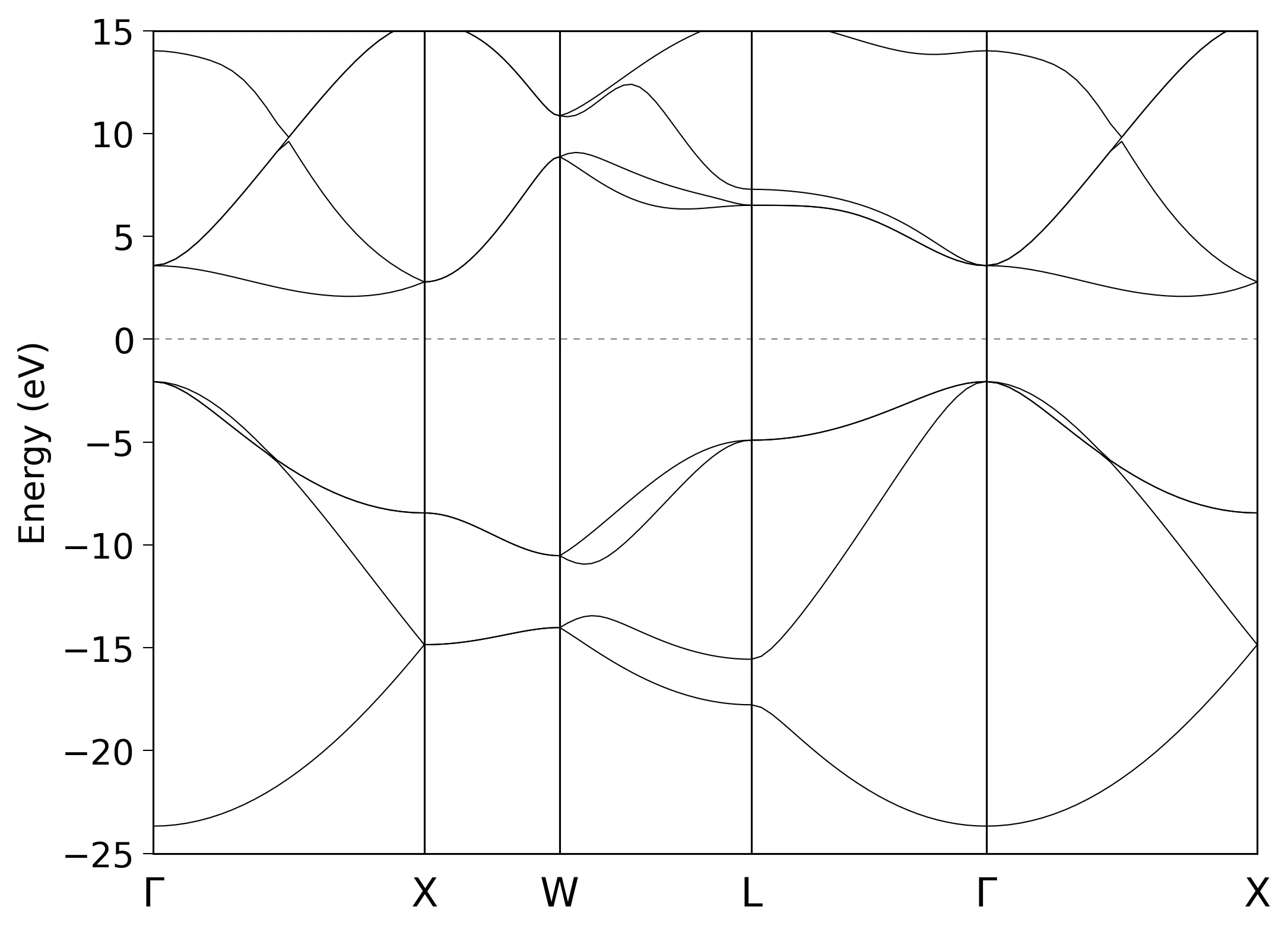
Next step is to extract bandstructure data from diamond.Band file:
bandgnu13 diamond.Band
Finally, we can plot the bandstructure using gnuplot or any plotting program of your choice:
gnuplot diamond.GNUBAND
Density of States (DOS)
DosMain diamond.Dos.val diamond.Dos.vec
It will ask few options interactively. Use of tetrahedron method is suitable.
The output file diamond.DOS.Tetrahedron will contain the energy, DOS and
integrated DOS columns.
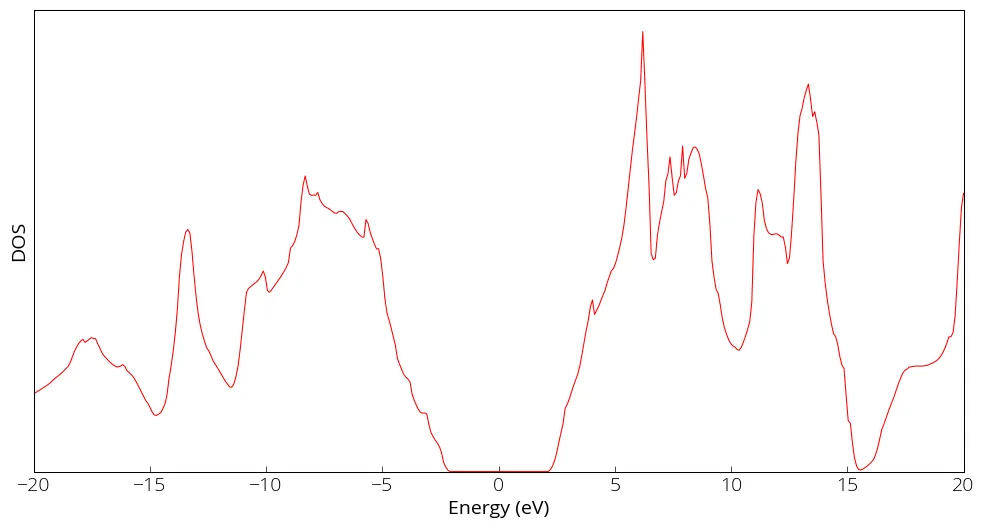
While running the DosMain program, you can also choose PDOS for projected density of states for each orbitals.